Alerting, digests & forecasts
kenny evaluates every telemetry snapshot with authoritative server-side health rules and
surfaces warn/crit on the dashboard — but in a family setting nobody watches a fleet
dashboard routinely. This page covers the push channel that reaches the operator's
phone when something changes for the worse (or recovers), the change and forecast
findings that ride the same channel, and the weekly digest. It is entirely
server-side: no protocol bump, no agent involvement, thresholds stay in health_rules.py
(see ADR-0029 and
ADR-0030).
Push alerting
A background loop on the server re-runs the health rules over every known agent's latest snapshot on a short interval (default 60 s) and notifies on transitions only — not on every push:
- Escalations to
critalways fire (ok→crit,warn→crit). warntransitions respect a per-scope cooldown (default 1 h) so a flapping section is bounded to one alert plus one recovery per window — no reminder spam.- A recovery is only announced if the degrading episode was itself announced. An
improvement that nobody was told about stays silent, and
crit→warnupdates state quietly.
The persisted flap-suppression state means a server restart never re-fires alerts for conditions that were already notified.
Offline detection is push-derived
An agent counts as offline when its newest snapshot is older than the offline
threshold (default 2700 s = three missed 15-min pushes) and the in-memory registry
holds no live tunnel connection. Health evaluation is skipped for offline agents, so a
stale snapshot can't flap. Offline PCs that are simply switched off will alert — tune
KENNY_ALERT_OFFLINE_AFTER_SECS or disable the loop entirely with
KENNY_ALERT_INTERVAL_SECS=0 if that is noise for your fleet.
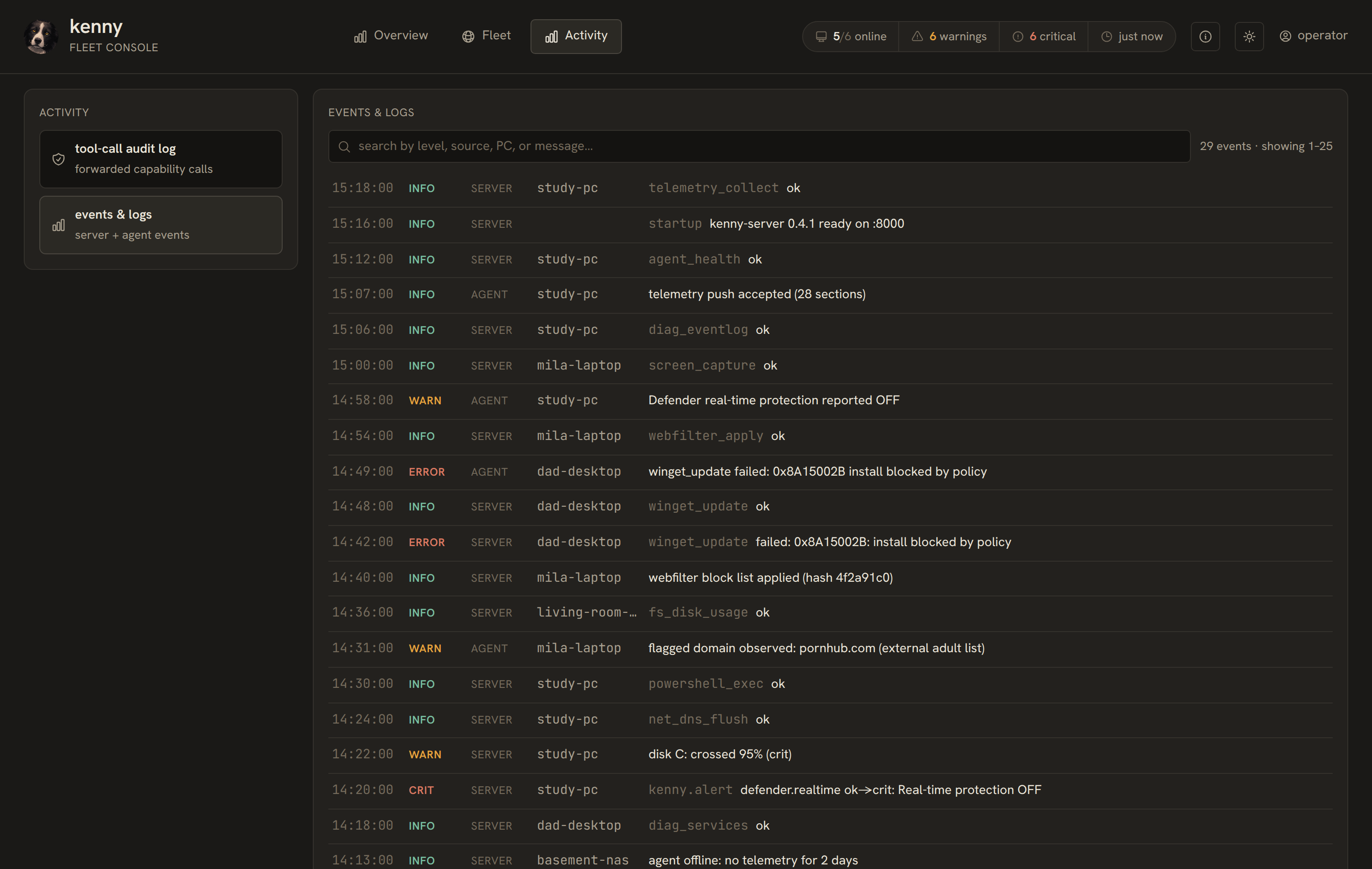
Every emitted alert is also written to the events table (kind='alert') as an audit
trail and as the weekly digest's input, so it shows up in the dashboard's Activity →
events & logs view with no extra UI plumbing.
Change notifications
A diff step in the same loop compares consecutive snapshots (once per new snapshot, tracked by a persisted cursor — never per evaluation tick, and never re-diffed after a restart) and reports what appeared, disappeared or changed in the inventory sections:
| Section | Diffed on |
|---|---|
autostart |
entry added/removed, command changed |
services |
service added/removed, start type changed |
peripherals |
device added/removed |
installed_software |
app added/removed, version changed |
browser_extensions |
extension added/removed |
listening_ports |
port added/removed |
scheduled_tasks |
task added/removed, action changed |
local_accounts |
account added/removed, admin/enabled changed |
Changes are batched into one notification per host. local_accounts changes (a new
account, or one flipped to admin/enabled) escalate to high priority — the
highest-signal security question in a family fleet. Sections absent from either
snapshot are skipped, so rolling out a new collector never floods the diff with "added"
rows for a whole section.
Forecasts
trends.py fits ordinary least squares over the per-day history (one representative
snapshot per UTC day). Forecasts are deliberately shy — they need at least 5 daily
points, a genuinely rising slope and a decent fit (r² ≥ 0.5), else they return nothing
rather than a scary made-up number:
- Disk-fill forecast — days until full per volume. Under ~14 days raises an alert (re-firing at most every 24 h); under ~30 days shows as an Overview KPI and in the weekly digest.
- Battery drift — health change as percent per 30 days; a meaningful decline appears in the digest.
These same computations feed the per-agent AI Forecast card at the top of the agent
drill-down, which synthesizes them (with the inventory diff) into a short prose outlook —
see dashboard.md.
Weekly digest
A plain-text weekly summary is scheduled inside the same loop and sent on the same channels at low priority. It renders — entirely from data already in the stores — the fleet health mix, degraded hosts, 7-day alert / change / crit counts, disk-fill forecasts, battery drift, pending reboots / failed updates / OS EOL, and 7-day screen time.
- Scheduled by default Monday 08:00 (
KENNY_DIGEST_DAY/KENNY_DIGEST_HOUR); the last-sent time is persisted so a restart never double-sends, and the first digest arrives at the next scheduled slot rather than on install. - Only sent if
KENNY_DIGEST_ENABLEDis on and at least one notifier is configured. - Preview it without sending via the operator-only endpoint
GET /api/digest/preview.
Notification channels
Delivery goes through two best-effort channels, both off unless configured (a single HTTP POST each):
| Channel | Configure with | Payload |
|---|---|---|
| ntfy | KENNY_NTFY_URL (+ optional KENNY_NTFY_TOKEN bearer) |
POST body to an ntfy topic; title/priority/tags as headers — works out of the box with the ntfy phone apps |
| Generic webhook | KENNY_WEBHOOK_URL |
JSON POST (kind, title, body, priority, tags, agent_id, at) |
Delivery is strictly best-effort: send errors are logged and swallowed, a dead target never stalls or kills the loop. With no channel configured, evaluation still runs and records alert history — it just pushes nothing.
Configuration
Alerting environment variables (see setup.md for the full list):
| Variable | Default | Purpose |
|---|---|---|
KENNY_ALERT_INTERVAL_SECS |
60 |
Evaluation interval; 0 disables the loop |
KENNY_ALERT_COOLDOWN_SECS |
3600 |
Per-scope flap suppression window |
KENNY_ALERT_OFFLINE_AFTER_SECS |
2700 |
Offline after this (three missed 15-min pushes) |
KENNY_DIGEST_ENABLED |
1 |
Send the weekly digest |
KENNY_DIGEST_DAY |
mon |
Digest day of week |
KENNY_DIGEST_HOUR |
8 |
Digest hour (0–23) |
KENNY_NTFY_URL |
(empty) | ntfy topic URL; empty = channel off |
KENNY_NTFY_TOKEN |
(empty) | Optional ntfy bearer token |
KENNY_WEBHOOK_URL |
(empty) | Generic JSON webhook URL; empty = channel off |
See also
setup.md— hosting, TLS, and the full environment-variable listdashboard.md— the Overview KPIs and the per-agent AI Forecast cardtelemetry.md— the sections and health rules these alerts evaluate- ADR-0029 — push alerting & weekly digest
- ADR-0030 — server-side diff & trend engine